The game zone business in India rewards operators who invest carefully and punishes those who rush. And nowhere does rushing create more lasting problems than in the supplier selection decision.
An arcade machine is not a short-term purchase. It is a commercial asset that will run under heavy daily use for five, seven, or ten years. The supplier who sells it to you will determine whether those years are operationally smooth or filled with downtime, disputes, and replacement costs that nobody budgeted for.
Punjab’s entertainment market is at a genuinely interesting stage right now. Cities like Ludhiana, Amritsar, Jalandhar, and Patiala are seeing new malls, entertainment complexes, and family entertainment centers opening at a pace that reflects the region’s growing appetite for quality indoor entertainment. Operators entering this market with the right equipment from the right supplier will build venues that define their local entertainment landscape. Operators who buy on price alone will inherit problems that compound over time.
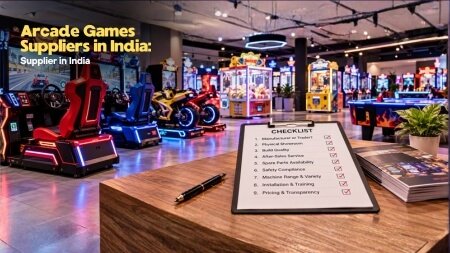
This 9-point checklist helps you evaluate any arcade games supplier in India the right way, before a single order is placed.
Point 1: Manufacturing Capability vs. Trading Operation
The first distinction to make about any supplier is whether they actually manufacture arcade equipment or whether they are a trading company that resells products sourced from third parties.
A genuine arcade games manufacturer in India controls product design, component sourcing, quality testing, and technical specifications. When something goes wrong, they can diagnose and fix it because they built it. A trading operation sells machines they do not fully understand and cannot fully support.
Ask directly: do you manufacture your own products? Where are the machines designed and engineered? What quality control processes do they go through before delivery? Clear, specific answers indicate a manufacturer. Vague or defensive answers indicate a reseller.
Point 2: Physical Showroom Access
Any arcade machine supplier who cannot show you their products operating in a live environment is asking you to make a significant commercial investment based on photographs and descriptions.
A physical experience showroom where you can play the machines, assess build quality, evaluate display and audio performance, and compare different products side by side is the minimum standard of transparency a serious supplier should offer.
For operators in Ludhiana and Amritsar who may be making their first significant game zone equipment investment, visiting a showroom with 100, 200, or 400 machines on live display gives you a quality reference point that no catalogue can provide.
Point 3: Commercial-Grade Build Quality Documentation
There is a fundamental difference between machines built for home or light recreational use and machines engineered for commercial FEC environments. In a busy game zone in Jalandhar or Patiala, machines run 10 to 14 hours daily under continuous public use. Consumer-grade components fail quickly in this environment.
Ask for specific documentation on build standards: cabinet material and gauge, screen specifications and brightness ratings, coin and card mechanism quality, internal component sourcing, and structural load ratings. A supplier confident in their commercial build quality will provide this without hesitation.
Point 4: After-Sales Service Response Time
This is the point where most operators underinvest in due diligence and where the consequences are most visible. When a machine breaks down during a peak Saturday evening in your Ludhiana game zone, how quickly does your supplier respond?
Ask for specific service commitments: what is the average technical response time for on-site service calls? Is there a domestic technical team or does every issue require communication with an overseas factory? Are spare parts held in a domestic inventory or imported on demand?
Vague answers to these questions are a strong signal to keep looking. A supplier who cannot commit to specific service timelines is a supplier who will not meet them.
Point 5: Domestic Spare Parts Availability
Machine downtime has two components: the time it takes to diagnose the problem and the time it takes to get the right part. The first is controlled by supplier technical capability. The second is entirely controlled by where the spare parts are held.
A supplier with a domestic spare parts inventory in India can resolve most component failures within days. A supplier who imports parts on demand when a machine breaks down introduces 4 to 6 week delays for every significant repair. In a commercial game zone, those weeks represent direct revenue loss that no discount on the original machine price can offset.
Ask specifically: do you maintain a domestic parts inventory? Which components do you stock? What is the typical lead time for a part that is not in stock?
Point 6: Safety Compliance Documentation
Every machine in a commercial game zone is used by members of the public, including children. Electrical systems, mechanical components, cabinet construction, and any moving parts all need to meet commercial safety standards appropriate for this environment.
Ask for safety compliance documentation for every machine category you are considering. A reputable game machine manufacturer will provide this without hesitation. A supplier who deflects this question or provides vague assurances is not a supplier appropriate for a commercial FEC environment.
Point 7: Installation Support and Project Management
Receiving equipment at your venue and having it fully operational are two different things. Arcade machines require correct placement, electrical connection, calibration, and testing before they are ready for commercial use. Some categories, particularly bowling alleys, VR systems, and soft play equipment, require specialist installation expertise that goes well beyond basic setup.
Ask whether the supplier manages full installation at your venue or whether equipment is delivered and installation is your responsibility. A supplier who manages the complete installation process from delivery to commissioning is taking accountability for the outcome. A supplier who delivers and disappears is transferring that accountability to you.
Point 8: References From Existing Customers
A supplier’s track record is the strongest indicator of what your experience with them will look like. Ask for references from existing customers in markets similar to yours, ideally operators who have been running the supplier’s equipment for at least 12 to 18 months.
Speak directly with those references about machine performance, after-sales support quality, spare parts experience, and whether they would buy from the same supplier again. This conversation takes 15 minutes and provides more useful information than any sales presentation.
For operators in Punjab cities like Amritsar and Patiala, connecting with other game zone operators in comparable North Indian markets who are already running the equipment you are considering is an especially practical step.
Point 9: Complete Project Capability
The most efficient game zone projects are managed through a single supplier who can cover the full equipment scope. When your racing simulators, redemption machines, soft play zone, kiddy rides, air hockey tables, and basketball machines all come from one accountable source, installation is coordinated, warranty management is simplified, and ongoing technical support has a single point of contact.
Ask any arcade games supplier in India you are evaluating about the breadth of their product range. Can they supply everything your game zone needs or will you be managing multiple supplier relationships for a single venue setup?
Planning a game zone in Punjab and want a supplier who passes every point on this checklist?
HGR Amusement has been supplying arcade and amusement equipment across India for over 30 years. Operators from Ludhiana, Amritsar, Jalandhar, Patiala, and cities across the country visit HGR Amusement’s Ahmedabad experience showroom to evaluate 400 plus machines in a live environment before placing any order.
Talk to HGR Amusement Before You Place Your Order
HGR Amusement: Passing Every Point on This List Since 1993
HGR Amusement is one of India’s most established names in arcade games suppliers in India services, FEC project support, and complete amusement equipment supply across 60 plus cities nationwide.
Physical showroom in Ahmedabad with 400 plus machines on live display. In-house technical team with pan-India service capability. Domestic spare parts inventory. Full installation management. Safety compliance documentation for every product category. A complete equipment range covering ticket redemption machines, racing simulators, VR gaming systems, air hockey tables, basketball machines, soft play equipment, kiddy rides, shooting games, bowling alleys, bumper cars, and more.
For game zone operators in Punjab and across India, HGR Amusement is the supplier that answers every question on this checklist with specific, verifiable information.
Call us: +91 9099918149 | +91 9099918505
Email: sales@hgramusement.com
Visit our Experience Showroom: 1-7, Parshvanath Estate, Gota, Ahmedabad – 382481